Topographical Changes 2026
18 May 2026 • 34 min read
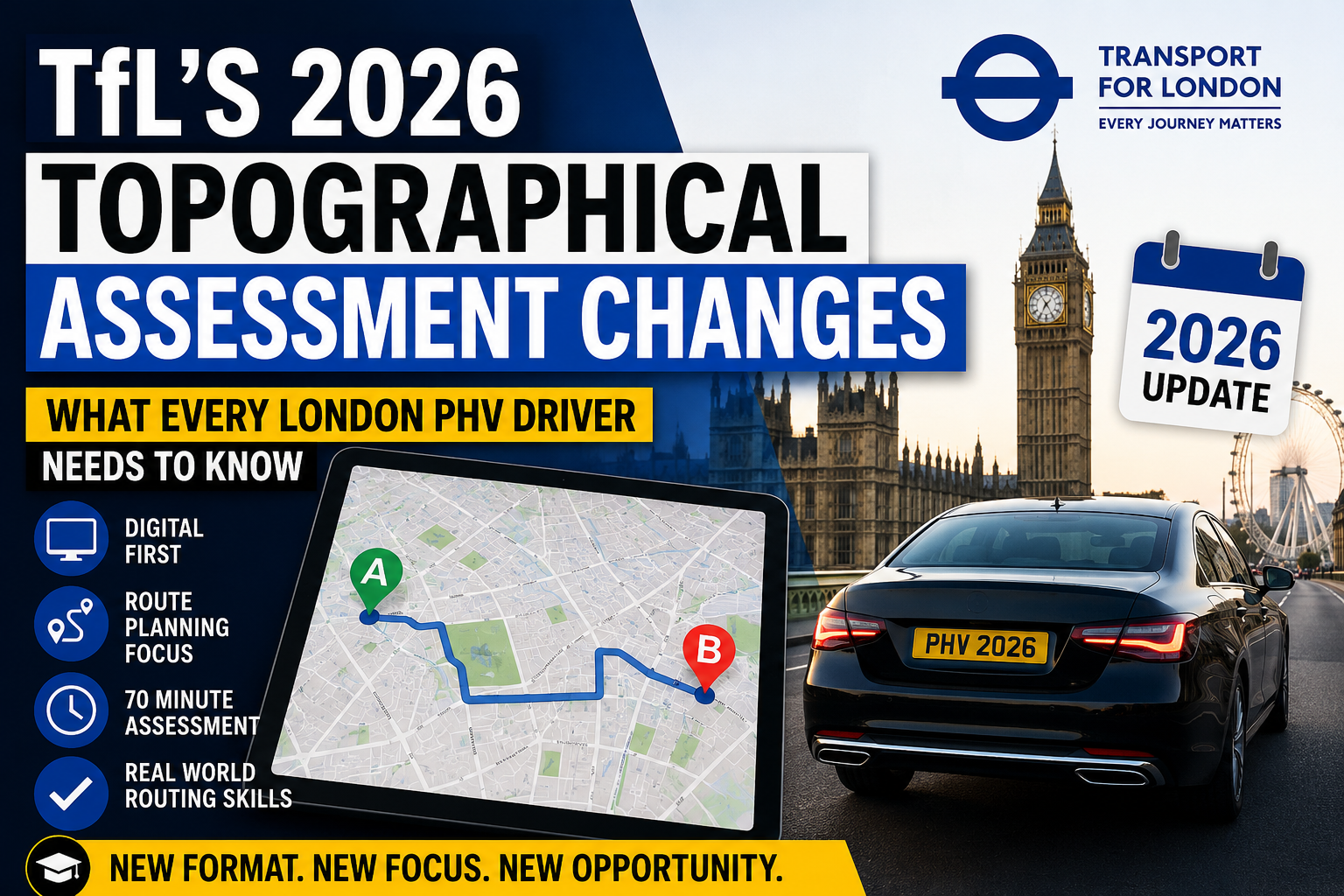
Transport for London (TfL) has officially modernised the Private Hire Vehicle (PHV) Topographical Assessment for 2026, introducing one of the most significant updates to the exam in recent years. The changes reflect TfL’s wider push toward digital competency, route efficiency, and improved professional standards across London’s private hire industry.
For anyone applying for a PHV licence — or preparing to retake the assessment — understanding the new structure is essential.
What Has Changed in 2026?
The biggest shift is the move toward a fully digital-first assessment format.
According to the updated TfL guidelines, the assessment is now entirely computer-based and places greater emphasis on real-time route planning using digital maps.
Key changes include:
- The exam duration has been reduced from 90 minutes to 70 minutes
- Route planning questions have been reduced from four to three
- Route planning now accounts for 66% of the total marks
- The exam consists of 24 questions in total
- Greater focus on digital navigation and map interpretation
- Increased weighting on practical route efficiency rather than atlas lookup skills
This marks a clear transition away from traditional paper-based navigation methods toward modern operational driving skills.
The End of the Traditional A–Z Era?
One of the most discussed changes among drivers and training centres is the reduced reliance on the physical A–Z Master Atlas.
While earlier versions of the assessment heavily depended on atlas indexing and page references, newer guidance and training providers report that TfL has shifted toward onscreen digital mapping exercises. (London Transport Tests)
The modern assessment now evaluates how effectively candidates can:
- Interpret digital road layouts
- Navigate closures and restrictions
- Follow legal and direct routes
- Understand map symbols
- Identify compass directions quickly
- Read live-style mapping environments
In practical terms, TfL appears to be testing the same real-world skills drivers use daily while working with navigation systems across London.
Why TfL Made These Changes
London’s road network has become significantly more complex over the past decade.
Low Traffic Neighbourhoods (LTNs), bus gates, cycle lanes, temporary closures, one-way systems, and environmental traffic controls have transformed how drivers navigate the capital.
TfL’s updated assessment reflects this reality.
The new format focuses less on memorising map books and more on assessing whether drivers can make safe, logical, and compliant routing decisions under pressure. (Transport for London)
This is especially important as private hire drivers are increasingly expected to:
- Reduce unnecessary mileage
- Improve passenger journey efficiency
- Navigate restricted roads legally
- Support safer streets initiatives
- Operate confidently in digitally managed road environments
Route Planning Is Now the Most Important Section
Under the new marking structure, route planning dominates the assessment.
TfL states that candidates lose marks for:
- Choosing indirect routes
- Planning routes backwards
- Ignoring restrictions or prohibited turns
- Starting or finishing incorrectly
There are now three route-planning exercises:
- A short route
- A short route involving a road closure
- A longer route across London
This means candidates can no longer rely on passing through multiple-choice sections alone. Strong practical routing ability is now essential.
What This Means for PHV Applicants
The 2026 changes make the assessment faster, more technical, and arguably more realistic.
Applicants who are unfamiliar with:
- digital maps,
- mouse-based route plotting,
- London traffic restrictions,
- or directional navigation
may find the updated test significantly more challenging than previous versions.
At the same time, the new format better reflects the realities of modern PHV driving in London.
Drivers who already work with live navigation tools and understand London’s evolving road network may actually benefit from the shift.
How Candidates Should Prepare
The old strategy of memorising atlas references is no longer enough.
Successful candidates should now focus on:
- Practising digital route planning
- Understanding London road restrictions
- Improving speed and accuracy under timed conditions
- Learning compass and directional awareness
- Becoming comfortable using onscreen maps
Most importantly, candidates should practise identifying the “most direct legal route” — because that is now central to the assessment scoring system. (Transport for London)
Final Thoughts
TfL’s 2026 Topographical Assessment update signals a broader transformation in London’s private hire industry.
The capital’s roads are becoming smarter, more regulated, and increasingly digital. TfL’s revised exam is designed to ensure drivers can operate professionally within that environment.
For applicants, preparation now requires more than map-reading knowledge. It requires adaptability, digital confidence, and a genuine understanding of how London moves today.
Those who embrace the new format early will likely have a major advantage.